
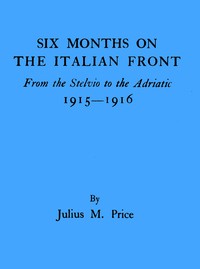
Six months on the Italian front by Julius M. Price
Most World War I stories come from soldiers or generals. 'Six Months on the Italian Front' gives us a different pair of eyes. Julius M. Price was a British artist and correspondent sent to the Italian Alps in 1917. The book is his day-by-day account of life alongside the Italian army as they fought the Austro-Hungarian forces in the brutal mountain warfare of the Isonzo front.
The Story
Price doesn't give us a grand strategic overview. Instead, he takes us with him. We travel by car and mule into the war-torn Alps. We stand with him in observation posts, looking across shell-cratered valleys. We feel the biting cold in poorly heated huts and taste the rough soldier's food. He describes the thunder of artillery barrages shaking the ground and the eerie silence that follows. We meet the Italian officers and soldiers, not as faceless troops, but as tired, determined men trying to hold a line in impossible terrain. The 'plot' is simply his experience—the anxiety of air raids, the exhaustion of long marches, and the constant, low-grade fear punctuated by moments of startling beauty in the mountain landscape.
Why You Should Read It
This book stuck with me because it removes the layer of historical hindsight. Reading Price's words, you're in 1917. You don't know how the war ends. His focus is on the raw, sensory reality—the sound of a particular shell, the look on a messenger's face, the struggle to draw while your fingers are numb. His perspective as an artist is key. He's trained to notice details others might miss: the way light falls on a ruined village, the posture of a sentry. It makes the horror more vivid, but also highlights the resilience and strange normalcy that soldiers create. It’s not a book about heroics; it's a book about endurance.
Final Verdict
Perfect for history buffs who are tired of battle maps and casualty lists and want to feel the grit of the war. It's also great for anyone who enjoys immersive first-person nonfiction. You need a little patience for the old-fashioned style, but the payoff is a truly authentic and moving snapshot of a forgotten front. Think of it as sitting down with a sharp, observant grandfather who happened to have a ringside seat to history. It’s a powerful, human-scale look at a global catastrophe.
No rights are reserved for this publication. You are welcome to share this with anyone.
James Johnson
2 months agoI appreciate how this edition approaches the core problem, the objective evaluation of the pros and cons is very refreshing. The insights gained here are worth every minute of reading.
George Jackson
5 months agoI've been looking for a reliable source on this topic, and the author manages to bridge the gap between theory and practice effectively. It’s a comprehensive resource that doesn't feel bloated.
George Rodriguez
2 months agoExtremely helpful for my current research project.
Elizabeth Thompson
1 year agoI started reading out of curiosity and the arguments are well-supported by credible references. This story will stay with me.


Margaret Johnson
8 months agoThe methodology used in this work is academically sound.